Inglinga

Inglinga

Wednesday, 12 October 2016

The Black Sun & the Resurrection of Ingwe

"When the Ice of the Darkest of Night melts away under the Fire of the Black Sun of the Inner Earth, the poison apple will fall away, and the Sleeping Goddess shall awaken, throw off the White Wolf Skin, and arise renewed by the Golden Apples of the Immortals. When the Moon is under her feet and she is clothed in the Golden Sun, she shall bring forth the Divine Child of Light who will lead the English in their Divine Mission against the Children of Darkness."
'The Prophecy 88' - November 9th 2014.
Researching more about our English past and that of the Divine Ancestor of the English I realised a point that has been obvious but which I overlooked in these works. In the above prophecy, given to me about two years ago, it is the Black Sun that awakens the 'Sleeping Goddess' (Idunn) who then brings forth the 'Divine Child of Light' who is the Last Avatar, of course. Past research has linked the Divine Child to Wid-Ar, The Hooded Man, HelgiH and to Ingwe. It is to the last one of these that we shall look at now - Ingwe - whose name means 'son of' and who is 'The Son of Man'.
To understand what I am saying here we need to return to an old part of the work dealing with one of the Prophecies of Nostradamus. This is the one quoted below -
'In the year 1999 and seven months, from the sky shall come the Great King of Terror. He will bring back to life the Great King of Angolmois. Before and after Mars shall reign supreme.'
Nostradamus : Century 10.
I have looked at this before but to make things clear will go through it again. In August 1999, one month out from the prophecy, the Solar Eclipse over Europe occurred; this is the 'Great King of Terror' mentioned by Nostradamus. This is also the Black Sun. This, it is said, brings back to life (i.e 'resurrects') the 'Great King of Angolmois', this, in the text I have, being an anagram of the Old French 'Mongolois' - which it is certainly not since the letter 'A' is missed out and an 'o' substituted! Far easier to see this as it is  - Angol- mois - 'Angol' being the English. Here we have the Great King of the English being 'resurrected' - this is the Resurrection of Ingwe.
The Prophecy 88 thus renews that of the one of Nostradamus, and not only that it's content also link to the Solar Eclipse of August 11th 1999 since we have the Black Sun in Leo the Lion (in the White Dragon in Wodenic Lore); in the same house of the zodiac we also had the planet Venus which is the woman 'clothed with the Sun, and the Moon under her feet'. Venus is here seen as the Goddess of Dawn linked to the Waene-Goddess, Freya. Indeed, although the phrase 'when the Moon is under her feet, and she is clothed with the Golden Sun' refers to a time of the year when, at dawn, the planet Venus is seen this way, this also applies to the time when the Sun and the Moon are 'conjoined' (Solar Eclipse).
I have shown the following runic-formula on many occasions but it is necessary to repeat it here to show that this fits in not only with prophecy, but also hidden within our own rune-rows -
Tiwas - The Sky-Father/The Sun.
Berkana - The Birth-Mother/The Earth Mother/ The Moon.
Ehwas - The Divine Marriage of the Sun and the Moon (Solar Eclipse).
Mannaz - The 'offspring' of the Divine Marriage - the Manu of the Aryans.
Lagu - The Flood/The Great Dissolution/The Waters of Chaos.
Ingwas - The Son/The Son of Man/The Divine Child of Light.
Dagaz - The New Dawn/The Rising of the Golden Age.
Odal - The Rising of At-al-land (Atlantis)/The Coming Race.
The coming of the 'Son of Man' (Ingwe) is after the flood, but we have shown that the 'Flood' may be more symbolic of the 'Flood of Migrants' (words from the press and media) into Europe - the Land of the Gods. The Bifrost Bridge was broken and the outlanders entered the Land of the Gods. Significantly, the above rune-row is the third and the last in the Common Germanic Futhark. Perhaps the Fourth AEttir of the English Rune-Row is the means to win the struggle?
In Norse Mythology it is Loki the Joten who is responsible for the theft of the Golden Apples and the abduction of Idunn. The gods have to force Loki to undo his dirty work and get her back. The symbolism of this myth is interesting, for she is turned into a 'nut' in order to get her away from the 'Giants' (Joten). The 'nut' is in itself a 'seed' and thus the symbolism suggests the 'Seed of Resurrection' or the 'Seed of Rebirth'. In the alternative version of Ragnarok, 'Odin's Raven Song', Idunn is equated with Nanna who is a Moon-Goddess and wife of Baldaeg. So well-known was Nanna at one time that the term is used for a Grandmother.
It is also interesting that none of the gods can awaken the 'Sleeping Goddess' (Idunn-Nanna) and under the orders of Odin they have to 'sleep on it', i.e. they have to let Wyrd take its course. This suggests that Odin recognised that she would awaken only at a certain time of the Cosmic Cycle, just as an Avatar appears at his appointed time. They could not force the matter! In this case it was the Black Sun of the Solar Eclipse that would awaken the Sleeping Goddess, who would then bring forth the 'King of the English' - Ingwe. This would bring into being the New Age - the Age of Ingwe.
Around the Solar Eclipse is always a 'halo' or 'corona' - a crown. This is an interesting part of this happening since the Guardian Goddess of England wears a White Wolf-Skin and a Golden Crown - according to a certain Initiate who was with us many years ago. 'Britannia' is the Guardian Goddess of England, and the Wolf-Goddess is the Guardian Goddess of the English, as we have see from past articles which refer to Norse Sagas. Both of these should be seen as facets of the same - Idunn.
Hamasson has also suggested that the English Ing-Rune is the Edel-Rune with a 'Crown', which is the Crowned and Conquering Son or the Crowned and Avenging Son. We have the crown linked to the 'Sleeping Goddess' and to the 'Son'. We also have the motif in Norse Myth of Woden Being swallowed by the Fenris Wolf; here we may see Woden (The Sun) being 'swallowed' by the Wolf (The Moon - wolves howl at the Moon). As in the Egyptian Rite of the Opening of the Mouth Wid-Ar prises open the jaws of the Great Wolf and allows the Spirit of Woden to escape. The Spirit of Woden enters his Son, Wid-Ar who is thus akin to Horus, son of Osiris. At a galactic level this could have been played out with the 2012 Sun moving into the Dark Rift of the Milky Way.
As I stated before the Solar Eclipse of August 1999 was the 'conception' of the Age of Ingwe; just nine months later (May 2000) was the planetary conjunction of the 'Cross of Ingwe' which was the 'birth' of the Age of Ingwe. Of course, before and after the 1999 Solar Eclipse wars were waged on the planet, as prophesied by Nostradamus in this quatrain. Mars, of course, is the God of War mentioned, but his Greek name is Aries. The name 'Aries' must be associated with Arya/Aryan and his Ram-Totem suggests a link to Hama-Heimdall.


In this clipping which I have shown so many times before Mars and Saturn are seen on the horizontal plane, the planets of War and Disaster. On the vertical plane are the Sun-Moon union (with Venus, not shown) in the House of the White Dragon, and the planet Uranus (*) in Aquarius, the ruling house of the New Age. The planet Uranus has always been associated with the Sky-God and with the Gods of Light & Order. The symbol of Aquarius, the Water-Bearer, shows her spilling the Waters of Chaos upon the Earth, the Waters of Dissolution, and we are witness to this today in the Dissolution of the Races. This is our greatest challenge, not to lose the Aryan Gene that is the basis of the creation of the New Man - the God-Man. In the midst of the Chaos around us an Age of Heroes is born, the Age of Ingwe. We can see the Germanic Ing-Rune in the clipping, as well as the Cross of Ingwe.
(*) Uranus = Ur-An-Us = The 'Primal Master of Fire'. UR means 'primal', AN means 'master' and Us means 'to burn'.
There are those who would cast out the English Cross, but when we consider the symbol of the Tegeingl (Deceangli) whose were based in Engelfield which is now Flintshire/Dyfed in North Wales, this is a Black Cross (Black Sun?) and four black birds which was associated with the 'Angli' or 'Ingl'. The 'Fleur-de-Lys' is the Irminsul of the Saxons.


The Cross of Ingwe


In the above Black Sun Crop Circle the four 'balls' are positioned as a 'Square', but if they are joined by two lines across the centre they make an X-Cross. The newspaper clipping is twisted from the normal zodiac by putting Leo the Lion at the top, thus making a +-Cross. The above X-Cross is still made up of the 'Four Beasts of the Apocalypse' - The Lion (leo) - The Man (Aquarius), and The Eagle (Aquila, which became Scorpio the Scorpion) - Taurus the Bull. The above positions this as the Solar Zodiac would be with an X-Cross, but it also has the Polar Zodiac through using the four Sig-Rune 'extensions' to the outer ring.
There is also a hint of something else here, since the four extended Sig-Runes come at points which cross at the junctions of two signs each -
Capricorn-Sagittarius and Cancer-Gemini.
Libra-Virgo and Pisces-Aries.
The Capricorn-Sagittarius area is the 'Gateway to the Gods' as I have shown before, and its 'anti-centre' is Cancer-Gemini. Pisces is the world-age we are now leaving, as we move into the Age of Aquarius. Aries was the previous world-age associated with the Ram. Here Capricorn-Sagittarius is at the north, the polar region.


The Resurrection of Ingwe comes at the same time as the Resurrection of At-al-land; they are connected since Ingwe would have been the God-Man who ruled over At-al-land. There is another interesting point about the name 'At-al-land' which I think I have mentioned before. There is another meaning to at-al -

at - to go (connected to the period gone through the revolving year).

al - beyond.

At-al-land is thus the land that goes 'beyond' the 'revolving year' - the zodiac. It is 'beyond' in the sense of being in another world or dimension, just like Hyperborea was said to be 'beyond' the north winds, beyond 'boreas'. This is why Hyperborea cannot be reached 'by land or by sea', since it exists 'beyond' the physical world. At-al-land is outside the Cycles of Time.


Monday, 10 October 2016

Gwydion - Son of Don.


Both Wotan's Krieger and myself have covered the topic of Gwydion, a god found in Welsh Mythology. It would be advantageous to read the posts on his blogs as well as this one. Researching this 'Celtic' god brings up some very interesting points, and once again underlines the fact that Germanic Mythology is really at the root of 'British' Mythology. When reading this it must be pointed out that here I refer to 'Germanic Mythology' as being Northern European, whilst 'Gallo-Celtic' Mythology comes from more southerly areas, obviously picking up some Middle-Eastern stuff since it is far nearer to this area.


Gwydion, as we have said, is Woden; his name begins with a 'silent G' and would be 'Wydion', which is 'Woden'. In Old Welsh the name would appear to have been spelt 'Guidgen' which is even closer to 'Woden' since the 'g' is silent. As W-K has pointed out the name Woden/Wotan/Odin is also spelt 'Guodan' or 'Godan'. The by-name of Woden, Gaut/Geat/Goth tell us that the original root was from 'Got', becoming 'God', and stemming from 'The Good'.  The name 'Jute' may also have the same roots. The 'd' and the 't' have always been interchanged as we find in Woden-Wodan-Wotan.

In all ancient tongues the vowels were not as important as the consonants, as we can gleam from a look at some languages; the vowels changed but the consonants did not. So the true root of 'WODEN'/'ODIN'/'WYDION' would be DN (the 'g' is left out, and the 'y' classed as a vowel since it is interchangeable with 'i'; the 'W' is a 'uu' or double-u and thus a vowel too).  

DN


Gwydion is the son of Don, and again we have the same Root DN. But we can go further still, for Don is the Welsh equivalent of the Irish Danu, whose name again contains the Root DN. In comparing mythologies we come across the problem that many of the names seem to be mixed up, do not tally with their counterparts in another mythology. This has to be kept in mind when we look at this. In Norse Mythology we have the Goddess IDUN(N), who once more has the Root DN in her name. Just as Gwydion is one of the 'Children of Don' we find that the same concept is held in Irish Mythology where we have the Tuatha de Danaan - 'Tribe (Children) of Danu'.

But this goes far deeper than this, for the son of Gwydion is Llew Llaw Gyffes which means 'The Bright One of the Skilful Hand' or 'The Fair One of the Skilful Hand'. His Irish equivalent is Lugh Lamfada. Now, the name 'Lugh' may actually equate to 'Loki' and when we find that Llew (we shall shorten this for ease) is slain by a spear, changes into an Eagle and hangs upon an Oak Tree we seem to have an inversion of the Aryan Myth, where Woden becomes Loki! Now, I say this since in Irish Mythology we find that Lugh (Loki) slays Balor (Balder). This is the correct version. Indeed, up until recently the name 'Llew' was translated as 'Lion' rather than 'Bright'/'Light'/'Fair'. As we can see from various areas where the Aryans have been a Ruling Elite but have gradually been absorbed into the native peoples, their mythology becomes distorted, indeed in many cases inverted.

Gwydion is a magician, prophet, poet and war-lord, and his roles are just the same as that of Woden. There is another quite obscure link to Woden found in the Welsh Triads. Gwydion is named as one of the 'Three Golden Shoemakers of the Island of Britain'. Woden is also quite famous for his 'Golden Shoes', the shoes of his horse Sleipnir. In some legends these are said to be left behind after his Wild Ride. Gwydion is also, like Woden' associated with the Ash-Tree. Caer Gwydion is the Milky Way - the Road to Valhalla.

His sister is Arianrhod whose name is said to mean 'Silver Wheel' and thus refer to her role as Moon Goddess. But she is also seen as the Goddess of the Dawn, equating her with the Morning Star. She is also, as her name suggests Aryan-Wheel which is enlightening. In fact this suggests that the term arian would have meant something else than 'silver' originally.

The Battle of the Trees is said to have been the work of Taliesin whose name means 'Shining Brow'. An interesting piece that he wrote is quoted below -

When I returned from Caer Seon
From contending with Jews
I will come to the city of Llew and Gwydion.

'Contending' means 'to struggle against' or 'to fight'. It can also mean 'to struggle in emulation', the very opposite.  'Caer Seon' is the 'Castle of Sion/Zion'. Unfortunately, Welsh Mythology is a mixture of native tradition and also of Hebrew-Middle eastern tradition. As I have stated before there are strange links to the Old Testament through many Welsh names, particularly in North Wales.

There is a Welsh word gwyddonydd which means 'scientist' and here we may well have a hint that Gwydion was originally a god of Aryan Science as well as his other roles - he certainly was a god who did everything to acquire knowledge. Here it should be noted that the original spelling of 'Gwydion' is the correct one, the later 'Gwyddion' (Gwythion) is a later interpretation. His name has been equated with Mercury Uiducus which seems to stem from *Uidugenos which is another angle to look at.

I am not aware of Idunn being known outside Scandinavian Mythology, since she does not seem to feature under this name in German Mythology. Since some have speculated that the Tuatha de Danaan came over from Scandinavia then finding Danu/Don here suggests that this name came from Scandinavia originally. Her name can also be found in England as I have shown before, since the 'Dane Hills' in Leicester are named after her (under the name 'Black Annis' a corruption of 'Anu', the 'D' being lost). The Tuatha de Danaan are linked to the Mystical Number 9 which is the basis of Norse Mythology. They are also said to have appeared in a 'Flying Object', which we need not go into here. They are also connected to the Four Hallows which lie at the root of the Holy Graal Mythus.

Going back to the Root DN of Wydion/Woden and Danu/Don/Idun(n), this may well have been an original pairing of a very ancient God-Goddess. Since these islands were once part of a larger European Continent, part of the western areas called At-al-land which were hit by vast catastrophes over a period of thousands of years, we can deduce that the Germanic Lore stayed on here even though thousands would have had to uproot and move, and outsider people may well have moved in. The majority of the people would have been Germanic, and the later 'Anglo-Saxon Invasions' were merely a return of a certain section of these Germanic Folk who brought back with them the true Aryan Mythology and Aryan Knowledge. In the process they waged a Holy War against the Joten who had upturned the Ancient Lore, distorted much of it, and introduced an alien religion into the Islands of the Mighty.

W-K mentions that Gwydion was introduced by Belgic Tribes, known to be Germano-Celtic, or a mixture of Germanic and Gallic maybe. Whether there is any link between the Belgae and the Fir Bolg of Irish Mythology we cannot tell, but the names are much the same.


Looking at this map reconstructing the lost lands of what we have called At-al-land we can see that the larger borders are of Germanic-Norse, from Belgium upwards, so this would have the most links to England and Scotland. It is quite possible that Ireland was ripped away from the mainland at a later time than the first catastrophes - a theme that Tolkien takes up in his Book of Lost Tales - Volume II.

With the sinking of At-al-land the peoples there would have scattered to different parts of the world, no doubt moving across the lands that were still linked to the European mainland, but also sailing off in their Swan-Ships or Dragon-Ships to other areas of the world. It is clear that the ruling elite of the Egyptians was at certain times Aryan, and we also know of the moves to Persia and India, as well as conjectured moves into the Himalayas of Tibet; we also have the Tocharians in the Tarim Basin, fitting with the legends of a great Aryan Civilisation being set up in the Gobi, when it was not a desert. But we also have the legends of the White Gods of the Americas, and especially the 'Inkas' whose proper title is 'Ingas', in whose area is the Atacama Giant (Chile) which so much resembles a stylized Long Man of Wilmington and the Cerne Abbas Giant (Herne Giant).


The Herne Giant (Dorset)


The Long Man of Wilmington (Sussex)


The Atacama Giant (Chile)


This is why it is so important to regain our true history and not the distorted history taught to our people in schools, colleges and universities today. The lands of At-al-land were most likely the centre of an advanced civilisation which crashed after a massive catastrophe that sank much of it in one go, then a process of thousands of years of further catastrophes resulted in these islands being completely split from the rest, and the only part of these lands left standing above the seas. Around 5,000 years ago the 'Isles of the Blest' perhaps stood where Dogger Bank is today, the last remaining stronghold of the most ancient Aryan Druid Religion of these lands. We can perhaps see now why our Ancient Lore and our English History has been distorted - to hide the truth of the great Germanic past of these islands, and even further back to the 'Atlanteans' and before that the Hyperboreans - for the Atlanteans were a remnant of the most ancient Hyperboreans.


The 'White God' of the Mayans
(Showing the markings as on the Stone of Ing - X - XX)


 Idunn is the Goddess of Regeneration and of Renewal (Resurrection) who guards the Golden Apples of Immortality. That she is associated with Golden Apples links her to Avallon (Valhalla) and also to the Legend of the Sleeping King - Woden-Arktor. It is no doubt one of her Golden Apples that saves the Divine Race of the Wolsungas from extinction. The powerful wizard, magician, seer, poet and war-god (Woden-Wydion) has been here in these islands for many thousands of years, his Woden Initiates have worn the Golden Torc in these lands in honour of his being 'God of the Hanged'.


 The Golden Torc

(The twisted cord of the God of the Hanged, worn around the NECK)


"From the ashes a fire shall be woken,
A light from the shadows shall spring;
Renewed shall be blade that was broken,
The crownless again shall be King."

Lord of the Rings


Sunday, 9 October 2016

Germanic Mythology in 'Celtic' Myth.

Whilst researching recently I came across a rather strange pair of names from 'Celtic' mythology. In the History of the Kings of Britain (Geoffrey of Monmouth) I found the following -
'After Hudibras came his son Baldudus who reigned for twenty years and built the city of Caerbadud now called Bath...'
The two names stick out like a 'sore thumb' as the saying goes - Hudibras and Baldudus - Hodr and Balder! And it was Balder (Baldudus also known as Bladud) who founded Bath. Here we have two famous Germanic God-names hidden within ancient British-Celtic Mythology, seeming to suggest that some of the Celtic texts are related to ancient Germanic Lore here in these islands.
The alternative spelling 'Bladud' is used most often and has very interesting roots -
bel/bal/bla = 'bright' (i.e. 'light'),
dud/dydd = 'dark', 'darkness'.
In the name we have the balance of Light & Darkness to Folkish Wodenists suggesting The Hooded Man. He is also associated with a guardian of gates and doorways, a 'Celtic' Janus. Alternatively, like Woden, he is a god of the Gates or Crossroads. He is also - like Balder - associated with the Sun, and in one interesting legend he flies through the air and crash-lands on the Temple of Apollo (Pol). This is no obscure myth but is an integral part of this 'Celtic-British' tradition, for both names come into the lineage of the Guardians of Britain -
Rhud Hudibras - Bladud - Llyr - Bran
Rhud Hudibras is said to stem from the Welsh rhod meaning 'wheel', a title also seen in the Irish Druid named Mog Ruith meaning 'Son of the Wheel'. Now, we have established a connection between Woden and Waendal through the Long Man of Wilmington, and Waendal is Mundilfore. The Long Man is the 'Guardian' and it would seem that both Bladud and his father Hudibras are associated with Janus - the Guardian. Of course, Mundilfore is the 'Turner of the Wheel' - the Cosmic Turner - who turns the Fire-Whisk into Creation.
Like Woden, Hudibras is associated with an Eagle; and like Woden his name contains the root 'Hud' - 'Hood'. Woden is 'The Hooded One'. Thus Hudibras (here seen as Woden) is the father of Baldudus (here seen as Balder). What we have lost is the brother of Balder, yet this can be easily explained through the alternative title of Baldudus - Bladud. In the latter we have the Light (Balder) and Darkness (Hodr) in the same figure.
Bladud is associated with the Wheel of the Sun just as the symbol of Baldaeg is the Sun-Wheel. In one legend of King Arthur, after his death, he is ferried to the magical realm of regeneration (Avallon or Valhalla) by a seer (Merlin), a bard (Taliesin) and a ferryman named Barintus, the latter regarded as being of the lineage of Bladud. Here we have a legend which contains a magician (Woden), a bard (Woden) and a Ferryman (Woden) taking the Once and Future King (Arctor) to Valhalla (Avallon). These figures seem to represent an ancient tradition in these islands relating to the Magical Guardians or Sacral Kings of the Land of Albion (not Britain as scholars would have it). Indeed, we could say that this is an ancient tradition relating to the Magical Guardians or Sacral Kings of the Land of At-al-land. It is also noteworthy that Bladud/Baldudus is associated with wells and springs just as Pol (a German name for Balder) is associated with wells and springs.
The son of Bladud is Llyr or Manannan mac Lir in Ireland; thus we find that the 'Son of Lir' is Manannan - Mannus. Taking this a step further the son of Llyr in Welsh Mythology is Bran, the god whose severed head becomes the Guardian of England, based in the White Mound which is now the Tower of London. Here the head is guarded by Ravens, and interestingly the two remaining Ravens are called 'Huginn' and 'Munin' - The Ravens of Woden! Of course, the 'Son of Mannus' (Man) is Ingwe! The name 'Bran' means 'raven'. The Ravens of Woden guarded the Islands of the Mighty until Arthur dug up the Head of Bran.
In the Battle of the Trees we find a conflict between one order and a New Order, one between Bran and Wydion (Gwydion = Woden). This would seem to hold a legend of a battle between older Germanic Tribes (Bran) and a later incursion using the name Wydion (Woden. Bran is linked to the Alder (older?) Tree and Wydion with the Ash-Tree!
Bran has an alternative spelling of 'Ban' and in a very old article in the original series of the Sword of Wayland I linked the name to 'Banbury' which is the 'Beran-byrig' symbolic of the Sacred Centre of England. If Bran is linked to this it thus emphasises his role as the Ancient Guardian of England. We are reminded of Mimir who has his head severed too, and Mimir is the 'Memory of the Blood'. It is in Mimir's Well that Woden gives his 'Mind's Eye' (Third Eye) where it is held through time, ready to be awakened once more.
We should also consider the Celtic figure of Mabon, whose name means 'son of' just as does Ingwe - he is the Divine Child, as Ingwe is the 'Son of Man'. His tale is simply that of the Divine Child who loses his rightful place in society, is removed from his mother, encounters a series of animal totems which appear to suggest a movement backwards in time to the source or origins, and finally gains this rightful place once more. This is extremely important in view of our knowledge of the Sinking of At-al-land and our search to regain At-al-land and the Golden Age. Here we should note that Geoffrey of Monmouth brings the Roman Janus into the picture, for in some legends Janus is the co-ruler of the Golden Age with Saturn.
Mabon is the son of Modron who is the Goddess of the Land; in fact she is Sovereignty the Guardian of the Land. It is she who gives birth to Mabon who has a human father, i.e. he is both God and Man. Mabon is the equivalent to Ingwe, or a Celtic name for Ingwe. The story of Mabon can be found in the tale of Culhwch and Olwen where we find a number of totem animals who appear to represent older races going back to the oldest of them all, the Salmon of Llyn Llyw who is the one who knows where the Divine Child is imprisoned.

The tales of Bladud, Mabon and Merlin have many similarities and it is hard not to see these being similar archetypes, or perhaps ancient tales which have through time lost part of their true meaning. The son of Bladud, Llyr, is the 'King Lear' who is supposed to have given his name to Leicester. He is supposed to have been buried in the River Sour and was linked to Janus through this tale. Mabon's tale also shows traces of the same one as Parsifal, which is not surprising. What we need to be careful of is to consider the influence of alien hands (the later Druids or 'truth-benders') on certain 'Celtic' myths, since I have shown elsewhere of the influence of the Old Testament on certain 'Celtic' works. We need to consider the role of the 'Anti-Race' in this, and that their role is to invert everything Aryan through their religion and work.

Perhaps the most overlooked prophesies, those that come from these islands, are the Prophecies of Merlin recorded by Geoffrey of Monmouth. These contain various obscure prophecies using the imagery of fabulous and mythical beasts. In it we find one where 'Orion shall unsheathe his sword' which is one found in Germanic Prophecy too. The same verses tell of various planets going off course, which (naturally) would cause chaos in our solar system if it did occur. This is not the place to go into these prophecies, but we shall feature them in a future post, although (as I said) they are obscure, maybe even more so that Nostradamus.
One of the things that came into my mind was the clear link between England, the English and Bootes (the Constellation of Ingwe). The most famous legend that has for centuries been told and retold is that of the Celtic 'King Arthur'. Yet this would seem to have been used against the English in one sense, which leads me to question not only 'why' but also if it was not yet another distortion of Aryan Myth, partly used to promote the spirituality of the 'Grail', partly to emphasise a 'Celtic Britain', suppressing the Germanic Roots of these islands, but also maybe to hide the true origins of the myth. Arthur may well be 'Arth Vawr' or 'Great Bear' but there is also the possibility that his legend relates to Bootes (Ingwe) through the brightest star - Arcturus. In which case the legend may well go way back to Ingwe and his reign in At-al-land.

Whatever the case more and more proof is arising to show that these islands are predominantly Germanic in nature, and that the English dwelt in this area when it was not an island but a large continent which stuck out from Europe into the North Sea and across to the Atlantic Ocean, an area known as At-al-land, whose sinking has come down to us through Plato who named it 'Atlantis'. The root of the word 'Atlantis' goes deeper than the root atl meaning 'water' (from the Americas) because it can be broken into -

Atl = At-al = Race,

Lant = Land

Is - probably, like 'us' this is a Latin suffix added on to a Germanic Name.

There may well be a link with the Greek god Atlas, who is the brother of Albion, the old name of these lands. Albion, as I have mentioned many times, can mean 'White Island' or 'Island of the Elves' ('Radiant Ones' or 'Shining Ones'). Ingwe, of course, is Lord of the High Elves.

Lastly, it is not unusual to see variations of god-names, or even names of gods transformed into humans. We have the clear example of Heathcyn and Herebald which appear in Beowulf, names which suggest Hodr & Baldaeg. The roots of both names are obviously Hod & Bald, and whatever variations are used does not change the essence.

Saturday, 8 October 2016

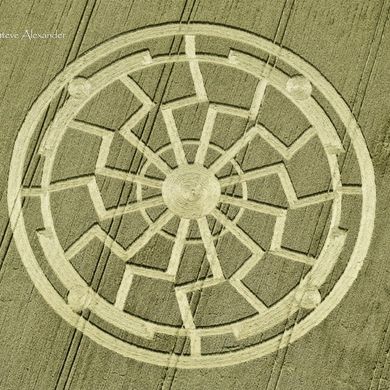
The Black Sun Crop Circles


The above crop-formation was the first of two similar circles which have appeared in Wiltshire, Southwest England. As we can see there are twelve 'rays' which move towards the central wheel and which are all Sig-Runes shown the normal way round. The Sig-Runes differ from each other in that the inner part is not the same for each one. Seven of these sections appear to be the same (the long ones), three are smaller, and two are smaller still. This would seem to be a variation of the Black Sun.


The above appeared on August 8th 2015 at Ox Drove, Bowerchalke in Wiltshire, and is much nearer to the Black Sun of the Wewelsburg Order Castle. However, there are differences which must have an importance. Here I am going to try to analyse these symbols. For the purpose of doing so we shall see the inmost circle as the Inner Sun, with three rings through which the Sig-Runes radiate - the Inner Ring, Second Ring and Outer Ring.
 
The 8th August 2015 can be seen as the 8th of the 8th (88) to which we can add the sum of the digits in 2015 - 8; this gives us the Mystical Number 88 but also the Mystical Number 888. The number 888 in Greek Gematria seems to refer to 'The Krist'.
 
There are 12 Sig-Runes but in this case they are shown as the reverse of the rune, suggesting an inward movement of the 'rays', i.e. implosive. This is exactly as the first version seems to show.
 
However, only 4 of the Sig-Runes go past the Second Ring, reaching the Outer Ring (8 go only as far as the Second Ring). These connect to the 4 wider sections in which are 4 smaller circles (4 + 4 = 8).


Looking at the symbolism using enhanced concentration the 'legs' appear to move anti-clockwise (widdershins) and since the 12 Sig-Runes are made up of three counter-clockwise Swastikas this is the 'Swastika of the Return' (return to Thule-Hyperborea).
 
The Outer Ring is broken into 8 sections by the 'balls' and the extended runes; again we encounter the Mystical Number 8 - the Symbol of Infinity.
 
The 4 'balls' or 'circles' on the Second Ring make a square; but if the whole thing was twisted round this would be a Germanic Ing-Rune. But the 'balls', in the position they lay, seem to suggest that the whole inner area 'revolves' inside the Outer Ring. This is further emphasised by the extensions on the 4 Sig-Runes, which do not follow the rune-shape but seem to be 'offset' or to 'refract' within the Second and Outer Ring.
 
Whereas the Wewelsburg Black Sun suggests that it is static, this one suggests a widdershins movement towards the origins.
 
The Wewelsburg Black Sun was based upon the Mystical Number 12 which is linked to many things -
 
  • Each day has 24 hours, made up of two 12-hour parts.
  • There are 12 months in a year.
  • The 'Twelve Tribes'.
  • The 12 signs of the zodiac.
  • Robin Hood and his 12 Merry Men.

But this version at Ox Drove introduces the Mystical Number 8 (Infinity-Eternity, i.e. outside the Cycles of Time), the Mystical Number 88 (The Avatar), and the Mystical Number 888 (The White Krist). It also introduces the idea of movement in a widdershins direction, added to the movement towards the centre (implosion). It is interesting to note that Nigel Pennick shows that in Greek Gematria the name 'Jesus' adds to 888, and that Nike ('Victory') adds to 88!

Focussing and un-focussing the eyes allows the 'spaces' within the symbol to come into being, in the process producing what seems to be a Hidden Spiral, moving towards the central circle. Here we need to consider that the Mystical Number 12 is almost always seen within the Formula 12 + 1 as in King Arthur and his Twelve Knights of the Round Table, Robin Hood and his Twelve Merry Men, Jesus Christ and his Twelve Disciples etc. (*). We can see in the Black Sun Crop-Circle the idea of the central point (1) plus the Twelve 'Rays', and also perhaps the central point (1) and the Mystical Number 8 (8 + 1 = 9). Here the Mystical Number 9 opposes the Number 6 associated with the six-pointed Star of Zion, itself linked to Saturn (Satan) who is a transmutation of the ancient God of the Golden Age.
 
If the Inner Circle is the Black Sun (Central Sun) then this stands atop the Midnight Mountain (Sacred Mountain - Me-Ru); from this runs the Four Great Rivers (the extended Sig-Runes); around the outer edge is the Circular Ocean (which is why the rays 'refract'); the Outer Ring is the Circular White Mountain Range that encloses the whole.
 
Hidden within the 12 Sig-Runes, emanating from the Central Sun (Black Sun), is the Sign of the Holy Fehm (Vehm). This is the Secret Tribunal that judges, passes sentence, and carries out the sentence in accord with Sacred Laws (in accord with the 'God of the Hanged'). This is the Triple Swastika symbolising the Laws of the Three Norns - the Law of the Rita.


(This is the reverse of the symbolism on the Black Sun crop-circle)


Miguel Serrano sees the Black Sun as illuminating the Inner Earth, i.e. within a different dimension or world, ruled by other laws or no laws. Is this symbol a message from the Inner Earth? Indeed, is this a message telling us of the imminent appearance of the Last Avatar? It has to be significant that this symbol appeared here in England in the area of the West Saxons, indeed in the area where lies the ancient Capital of England - Winchester. What is also significant is that Miguel Serrano mentions a new rune, the Venuris Rune - which is an 8-pointed star symbolic of Venus. The emphasis upon the Mystical Number 8 in the crop-circle is thus linked to the new rune.

There is also an interesting link between the Mystical Number 8 and the legends surrounding Frederick the Second and his Castel del Monte. This castle was built around two octagons (8-sided figure) within which are 8 trapezoid rooms (8-8-8). This was the Castle of the Master of the World - a significant title that should be meditated upon. At this castle the Emperor presided over a kind of 'Round Table' of heroic knights, including the Teutonic Knights and the Knights Templar, this becoming known as the 'Secret Pact'. The root oct is related to the idea of 'seeing'. (**)


We see here the 'map' of Hyperborea showing the Sacred Mountain at the centre and the Four Great Rivers running outwards into the Circular Ocean. The symbolism is hidden in this latest version of the Black Sun. Note also the four 'circles' which appear as a square in the four corners, just as the four circles of the crop-circle. The Black Sun symbolism in the crop-circle is thus the Black Sun that illuminates Hyperborea. The crop-circle is arranged as three concentric rings, does not this remind us of Plato's description of Atlantis? Is it not then true to say that Plato's description was as much symbolic as factual, and that this symbolism is of Eternal Atlantis or Eternal Hyperborea, and that this symbolism recurs over and over within the Eternal Return? This suggests the manifestation of Hyperborea and the Golden Age of Perfection.


The above is from an alchemical work called Splendor Solis and is called the 'Rising of the Black Sun'. We can see the symbolism clearly since in the foreground we see death in the form of a couple of dead trees, yet in the background there is life or New Life forming. The Black Sun is seen emerging from the Earth, giving off Golden Rays of Light (Golden Age). But what is most significant is that it seems in this work the Black Sun is not associated with the Nigredo (Black) of alchemy, but with the last stage, Rubedo (Red), which is the Red Vajra of Resurrection according to Miguel Serrano. We can thus see the Black Sun as not only the 'Dark Night of the Soul' and the 'Dissolution', but also a symbol of the 'Resurrection'.


This 'Jain Swastika' appeared here in England in 2016; note the four circles or 'dots' once again! There seems here to be a pattern in which the earlier circles were of many different cultures (but maybe the same roots?) and we are now seeing a subtle change where Indo-European Symbols are arising amidst the others. Also note the circle around this symbol. These messages appear all over the world, but are mainly centred here in England - this has to be significant. The main area is also around Wessex, the ancient heartland of the West Saxons whose banner was the Golden Dragon of Germania.
 
The appearance of these symbols prove beyond doubt that the Esoteric War is directed by the Hidden Masters from a parallel world - the Inner Earth. From this Inner Earth emanates the Will of the Masters (Gods) who direct and guide the Aryan Initiates on this Earth. As I have stated before, I have been a witness to a very similar type of occurrence to that of the formation of a crop-circle, when I witnessed a kind of 'vortex-wind' that flattened grass near to an old stone circle in Gwynedd, North Wales, not far from a larger stone circle called 'Druid's Circle'. The power behind this 'vortex-wind' seemed to be intelligent and I could 'feel' its presence as it happened.
 
What we have in this Black Sun crop-circle is a symbol of the most ancient Hyperborea, but also connected to the later At-al-land in the North-west. Indeed, it fits the description of Plato's Atlantis too, which may have been a description of At-al-land - the 'Atland' of the Oera Linda Book and of Spanuth. It is a symbol of resurrection and thus may be connected to the idea of the Rising of At-al-land, or even to the resurrection of the Avatar. The latter is actually hinted at through the numerical sequences centred around the Mystical Number 88 and the Mystical Number 888. Below is a Runic Talisman with the meaning of the Resurrection of the Spirit 88; it is perhaps now time to reveal its inner meaning -


  • At the bottom is a Germanic Ing-Rune within which are two Wyn-Runes placed back-to-back. Wyn is the 8th Rune and thus we have the Mystical Number 88.
  • The two Wyn-Runes each have three staves, these represent 'Spirit' and the 'Spiritual Realms'.
  • The central glyph is the Ur-glyphic Irminsul, which represents the Cosmic Axis/Sacred Centre; it is also symbolic of regeneration and 'resurrection'.
  • The top symbolism is that of a Peorth-Rune turned onto its back; this is the Sun-Ship or Swan-Ship that floats upon the Ocean of Chaos at the dissolution of the worlds. It is also perhaps the Wafeln of Miguel Serrano. (This is why such Aryan Heroes as Scef and Beowulf appear from over the 'seas'.) The rune is the 'Birth-Rune' being a Beorc-Rune opened up. It represents the Resurrection of the Avatar' or 'Resurrection of the Hero'.
  • Inside the Peorth-Rune are again two Wyn-Runes (88) but this time each one has four staves representing materialisation and manifestation into matter (4 = matter).
  • The whole thing represents the 'Resurrection of the Avatar'. 


The above shows the same type of Magical Talisman but is clearer to see and shows the Irminsul as it is usually drawn. This design was done by German Rune-Magicians some years ago and was passed to me through an Odinic Rune Magician in the South of England. Another Odinic Magician, based in the Scottish Highlands, was given a walking-staff carved with the design, from which the above came from. These two talismans are in fact carved into pieces of oak barrel from an ancient (heathen) festival held in the Scottish Highlands - the Burning of the Clavvie.
 
Another link to the coming Avatar is contained in yet another numerical sequence contained within the complex structure of the formation. There are 12 Sig-Runes, each made up of 3 sections (12 x 3 = 36); add this to the Number 8 and we get 44, half of 88. But 44 itself is a Mystical Number of Importance, since David Lane (Wodensson) mentions in his works that there are 44 letters in the first verse of the 'Bible' (Old Testament) and 44 letters in the last verse (New Testament), adding up to 88. 'Jesus Christ' (or rather the White Krist of Revelation is referred to as 'The First and the Last' and 'The Beginning and the End', as well as the 'offspring of the Morning Star (Venus - see the piece on Quetzalcoatl).
 
The Black Sun crop-circle seems to be so complex in its form and meaning that it hardly seems likely that it has been done by human hands; indeed, it seems to have kicked up such a stir that people were stopped from going onto the fields to see it at the time. It would also seem that when the crop-circle appeared a comment posted about a picture of the formation on Facebook asked for it to be removed and censored - so afraid are our enemies of what is coming! The area around Wiltshire has seen more crop-formations than anywhere else in the world, and it is also an area full of famous ancient sites -
 
  • Stonehenge,
  • Avebury Stone Circle,
  • Silbury Hill,
  • Uffington White Horse,
  • Wayland's Smithy,
  • Barbury Castle,
  • As well as numerous other ancient sites, too many to mention.
  • 
It would seem obvious that the area around Wiltshire was at one time one of the most sacred sites in these islands; we may conjecture that this applied way back at the time of At-al-land. Every one of these sites has English names even though every one has been associated with a 'Celtic' past. (Note: some of these are in Oxfordshire but this is due to a political border change and were originally in Wiltshire.)
 
Looking through some of the stuff written about this crop-circle I found one which mentioned Quetzalcoatl which was designed to brush off the 'Nazi' connection of the Black Sun. Unfortunately for the writer it did no such thing and emphasised further links to the Mystical Number 88, as well as bringing the planet Venus into the equation - Quetzalcoatl having links to Venus. In fact Quetzalcoatl was another of the archetypes based upon 'He Who Returns'! He was the Feathered Serpent and one of the White Gods of the Americas who was prophesied to return after he left. Indeed, the Spanish Cortes was taken to be the return of the 'White God'.
 
Another post on the subject investigated a link to 17th August which some see as a significant year; here I will show what this can mean to some -
 
  • August 17th was said by some sources to be linked to the appearance of Kalki Avatar.
  • August 17th was the date of the death of Rudolf Hess in Spandau Prison. I have it on the authority of a late Odinist Magician here in England that he was told by two different sources from Germany that both had clear visions of the Wewelsburg Black Sun at the precise time of Hess's death!
 
Yet another post on a different site mentioned a dream of mountain within an ocean, topped by an eclipsed sun (Black Sun) and a 'lighthouse' that illuminated the scene. This dream is very significant in that it shows an archetypal picture of the Sacred Mountain (Midnight Mountain) topped by the Black Sun; the Sacred Mountain being within a mass of water. (I have to add that the site was not sympathetic towards National Socialism but was clearly open-minded on this subject.) The dream was in 2012! (In regard to this it would seem that the Sun actually moved into the 'Dark Rift' of the Milky Way around this time.)
 
Finally, on the same day, 15th August 2015 (888), there also appeared a 'dove' formation at a place called Hampton Lucy in Warwickshire. The importance of this cannot be over-emphasised since the name 'dove' stems from 'diver' (some still say 'dove' rather than 'dived') and has been an old symbol of the coming of an Avatar! This links directly to the 'Spirit 88' and the numerology of the formation.
 
To sum up, this formation of 8th of the 8th 2015 seems to 'update' the original symbol in the North Tower of the Wewelsburg Order Castle, and in doing so hint at the coming 'resurrection' of the Avatar (and Aryan Leader) who appears riding a White Horse and carrying a Flaming Sword (comet?). This is reinforced by the 'dove' found in another crop-formation on the same date. 2012 was an important date since this was based upon symbolism of the Black Sun when our Sun entered the 'Dark Rift' (womb?) of the Milky Way.
 
Miguel Serrano sees the Black Sun as an ancient Sun that illuminates the Inner Earth and may represent Baldaeg in the Underworld, the Ancient Aryan Sun-God slain by the wiles of Loki. The Hyperborean Blood is the Igneous Fire of the Black Sun that runs in the Blood of the Aryan Folk - Blavatsky's 'Race of Hope'. This is associated with the Sang Real ('Blood Royal') or San Greal ('Holy Grail'), since the Quest for the Holy Grail is a quest for the 'Blood Memory of the Black Sun'.


 (*) In the 12 + 1 idea this numerical value is returned to its original when we see that within the group is 'The Betrayer' - the 'Judas' who represents those who who receive the 'Thirty Pieces of Silver' for betraying their leader. In a sense this represents the White Traitors who betray their own kind, but it can also represent Loki the Joten who is the 'Enemy Within'.
 
(**) The post about the crop-circle mentioned earlier sees this as the Dark Eye of the Soul and when we consider the root of oct and thus eight the numbers used in the formation are certainly significant.
 
There is one last and indeed important point that I would like to share now with you. A recent comment on 'The Mysteries of Ingwe' provoked a short discussion between myself and the author in which it was hinted that the Black Sun could also represent the Great Void in the area of Bootes - the 'Ox-Driver'. On seeing this at the same time as researching this post I cannot but consider this idea as maybe having some importance, since the Black Sun crop-circle appeared at Ox Drove.
 
Just as I thought that I had finished this post I had a conversation with one of my sons and some more stuff came up. Just a thought here. The Black Sun crop-circle had appeared 3 years after the 2012 'Black Sun' and in seeing this as showing movement it occurred to me that the Black Hole (such as at the centre of the Milky Way) can be dormant for many years and also show signs of becoming active again, i.e. showing a movement of energy. Is this perhaps what we are seeing now? I have shown how Bootes is associated with Ingwe and with England, and this may suggest some form of energy-transfer at this time that will awaken the At-al-land Archetype and the Coming of The Hooded Man.


Going back to the comments made on this blog it has been suggested that Bootes is here the Edel-Rune (The Hooded Man). I can go with this since The Hooded Man is also Ingwe, or at least the archetype has the same essence. It is also associated with Woden (who, like Vishnu may be the basis of each different Avatar) since he is the Driver of the Waen (Big Dipper here). This is all in the North-West, the area of At-al-land.
 
"The next Buddha will come from the West and from the North and will be the Kalki Avatar of the Hindus, or Kundalini-Avatar who will wear on his finger the metal ring of Genghis Khan (***)...His coming will mark the return of the Golden Age, and will precede the advent of the Radiant Ones...It will be the end of the Kali-Yuga, the casting out of the Joten and the cacodaemons from the governmental centres of the Earth..."
 
Robert Charroux.
 
(***) The ring of Genghis Khan was said to have been a Swastika Ring.


POST SCRIPT -

1. After further thoughts on this the idea of the Black Sun starting to send out new waves of energy (from either the Black Hole at the centre of the Milky Way, or the Great Void of Bootes, which would 'energise' the Black Sun at the centre of the Inner Earth) the thought of the Prophecy 88 came into my mind -

"When the Ice of the Darkest of Night melts away under the Fire of the Black Sun of the Inner Earth, the poison apple shall fall away, and the Sleeping Goddess shall awaken, throw off her White Wolf Skin and arise renewed by the Golden Apples of the Immortals. When the Moon is under her feet and she is bathed in the Golden Sun, she shall bring forth the Divine Child of Light who will lead the English Folk in their Divine Mission against the Servants of Darkness."

88 words given to me on November 9th 2014. Here we have the energy of the Black Sun melting the 'Ice of the Darkest of Night', and thus awakening the 'Sleeping Goddess' (Idunn - here the Guardian Goddess of the English and of the Land of England).

2. In a previous post about the Hale-Bopp Comet and At-al-land I mentioned that the 33 runes which were passed to me from a fellow Folkish Wodenist may have been the Lost Runes of At-al-land. Looking back at this post in line with what I am saying here there may be something in this. Two Roman historians mention that the earliest shape of England was an 'elongated diamond', i.e. an Ing-Rune. There are no less than 11 of this type of Ing-Rune in this rune-row, and as I stated before the Edel-Rune (AEthel-Rune here) is a Diamond-Ing Rune with an arrow pointing downwards, thus suggesting the sinking of At-al-land. This 'arrow' also appears on 11 runes too. 11 is a multiple of 33 of course.

3. It should also be noted that the Atland or Oldand of the Oera Linda Book is the land occupied by the Frisians or 'Folk of Frya'. We would call these the 'Folk of Freya', but the name 'Frisian' could just as well be 'Folk of Frey', and thus the 'Folk of Ingwe'. The Frisians are close kin to the English, and the 33 runes are the Anglo-Frisian Rune-Row (which brings into doubt the 'running script' of the Oera Linda Book which itself appears to be based upon the Roman Alphabet).

Friday, 7 October 2016

Awakening of The White Dragon


The revival of the White Dragon Banner started back in the mid-1980's through the original White Dragon Kindred. Woden's Folk was formed on April 23rd 1998 and took up the revival of the White Dragon, which soon spread when it was made into a flag by the English Flag Society, who worked separately in reviving the symbolism, although the idea was put into the magazine of The English Companions (using the pseudonym 'Folk-Wolf') so we cannot tell whether it had been taken up from here or not. Whatever the case the White Dragon was revived and spread through Englisc Nationalism.
The symbol spread very quickly, and at one time I did warn that we would be well not to totally discard the English Cross which began to be suggested. This was only because the White Dragon was, and still is, not well known amongst the English people at large, indeed when it is used many see it as a 'Welsh' flag. There have been arguments against its use because there is little historical evidence to show that the English used it as a symbol. This really does not matter at all since it is the symbolism that counts, and this symbolism is relevant to our struggle today.
The White Dragon is the symbol of the struggle against the Red Dragon of Juda-Rome, the 'Great Red Serpent' mentioned in Revelation. The 'Red Serpent' or 'Red Dragon' is symbolic of 'Rome', the 'Treaty of Rome' (The EU), the USA (which sports the Roman Eagle as its symbol of imperialism) and the British State. It is also the Serpent Rouge of the Priory of Zion. The conflict of the Red Dragon and the White Dragon in these islands goes back into the mists of time, and the use of the symbol as a Saxon Symbol (by some Welsh chroniclers) is interesting in that the Saxons came to these islands to counter the growing Judaeo-Christian Church which was taking control here. The later Vikings took up the struggle against the Christianised English, some of whose rulers were backing the growing Frankish Christian Empire - the Vikings came over in their Dragon Ships.


On a section of the Bayeaux Tapestry we see a Golden or White Dragon (wind-sock) on the ground, suggesting that it is the symbol of the defeated English, whereas a Red Dragon flies above it. This is significant, since it shows the Red Dragon triumphant. In 1485 the victory of Henry Tudor (Henry VII), who fought under the Red Rose and Red Dragon, secured the ultimate defeat of the White Dragon (White Boar in this case, since Richard III used the White Boar and the White Rose).
An exceptional book that concerns itself with the Battle of Bosworth is 'The Battle of Bosworth' by Michael Bennett. The front cover illustration is of Henry Tudor recovering the crown at Bosworth, but below this is a White Dragon shown on its back in defeat, together with the sceptre and crown - a White Dragon! True, the dragon shown defeating it is also white, and not red, but the symbolism is still very interesting. I am not suggesting that in either case these were put there deliberately, but since Archetypal Myth works in subtle and hidden ways they may be unconscious workings.
  • The White Dragon is the White Sun, which is symbolic of dawn, of the spring (Whitsuntide) and thus of rebirth and renewal.
  • The Golden Dragon is symbolic of the Golden Sun, of summer, of growth and of life.
  • The Red Dragon is symbolic of the Red Sun, the autumn sun as the sun sets in the West, of the Dying Sun.
Now we see the importance of the White Dragon since this period is one of the rebirth of the English, of the regeneration and renewal of the English Folk-Nation. But this has a specific importance here in these islands - the White Island (Albion) - which I am now going to relate. The Vedas allude to a 'White Island' or 'Island of Splendour' but this is usually taken to be a mythical realm. But we also have the reference to Scef coming to the Island of Scandi, a name also meaning 'Island of Splendour' or 'White Island'. Again, this is taken to be a mythical realm. But looking to the last post about Iggdrasil & The Runes if such a Holy Island exists in another realm or world then it has to have its parallel in this physical world. Thus, we could surmise that Albion is the area in which this mythical realm exists in another dimension. The symbol of Albion was the White Rose, and we can assume also the White Dragon.
In Wodenic Lore the Seven Swords of Wayland are symbolic of the Seven Tribes of Ingwe who have come together in these islands, and who make up the English Folk-Nation. These tribes have come from Northern Germany, Frisia, Sweden, Denmark, and Norway through the 'Anglo-Saxons' and the 'Vikings'. Northern Germany and Scandinavia were populated by the Ingwaeons ('Friends of Ingwe') who have thus united into one nation here in these islands. The Seven Swords of Wayland are a counterpart to the Seven Swords of the Seven Sons of Mimir. These swords are taken up just as Ragnarok approaches. These Germanic Tribes have united under the White Dragon Banner.

The Seven Swords of Wayland are thus an important symbolism, even though they are found in a TV Series (remember that all this is archetypal); the Seventh Sword of Wayland is named 'Albion' and is wielded by The Hooded Man. Albion is an ancient name for England, and since Hengest is one of the Divine Twins, and thus Divine Ancestors of the English, he is the same archetype as Ingwe (and also The Hooded Man). In previous articles I have likened the Seventh Sword of Wayland to the Sword of the Wolsungas, i.e. the 'Broken Sword'. Albion = The White Island = The White Dragon.
The arguments against the authenticity of the White Dragon as an English Symbol are a smoke-screen to divert the attention away from the importance of the Inner Symbolism which works at a subtle level that can be seen throughout history. The revival of the White Dragon came with the revival of an English Consciousness which itself resulted in the rise of a new Englisc Nationalism, which grew stronger and stronger but floundered due to its lack of strong roots. This is a point of importance because for anything to grow strong and healthy it has to have strong roots.

From an Inner Centre - a Mystical Centre - came the orders to certain Aryan Initiates to move their peoples to the Land of Albion. Thus the Seven Tribes of Ingwe came together in these islands in order to prepare for the Final Conflict between the Island Dragons - the White Dragon and the Red Dragon. Today we are witness to the fact that certain people are 'driven' or 'lead' by an Inner Drive to achieve some set purpose (destiny?). And so it would have been in the past. In order to understand thus further we need to get to the roots of the nature of Ingwe.

Ingwe is the Divine Ancestor of the English - the Inglingas ('Sons of Ing') - and he thus ruled over this Germanic Folk way back in the times when the continent of At-al-land existed, prior to its destruction which may have started some 8,000 years ago. Ingwe was a Germanic God (later known as Frey), and his incarnation marks the creation of the English Folk. He was also known as Sceaf/Scef whose legend tells us he was sent to the Island of Scandi ('Island of Splendour' or 'Shining Island'); his legend was also that of Hama/Heimdall. (It should be noted that these are archetypes and thus differ in form and essence.) The White Dragon is thus also symbolic of Ingwe.

At this point I am going to look at the TV Series called The Vikings which is certainly not 'historical' (if there is any such thing since history is often distorted) but which has a certain essence of interest to us here. The usual interpretation of the Vikings coming to England is that they came due to lack of good land to work, or because of something that displaced them from their lands. Well, may be there is some truth in this, but with all events there can be found an 'inner' meaning.

In the series Ragnar Lothbrok is the one who has the 'drive' to lead others to the 'West', to the Land of Albion. But, as clearly shown in the opening scenes, he is guided by the god Odin. It is Odin that guides him to go westwards to these islands, as if guided by an 'Inner Voice'. Yes, the outward drive is aimed at plunder and the acquisition of wealth, which is a 'human drive', but this is certainly not the Will of the Gods. Of course, we do not see this aspect, but as in the historical Viking incursions the target was the Christian Church which here in England supported Charlemagne who was spreading the alien Middle-Eastern religion across Northern Europe with fire and sword. So we can see an 'Inner Drive' that is not obvious to the majority of scholars. It is likely that the same applied to the earlier Saxon incursions and invasions.

The Royal Dynasty of Sweden (the Swedes being very much part of the early Germanic Tribes as shown by the Wuffingas) were the Ynglings, and the early Royal Dynasty of Norway were also Ynglings. So we have here a number of Scandinavian Tribes claiming descent from Ingwe. Admittedly, we cannot link any of these to the White Dragon, but since we do have the link made by Welsh Chroniclers these people certainly knew of the symbol used of the Saxons. In the Mabinogian we have a reference to the Coiled Golden Worm of Germany which refers to the Golden Dragon of the West Saxons. I have already shown that there is an underlying reason in using the White Dragon and not the Golden Dragon.

It is important to recognise that in Wodenic Mythology the Sword of Hengest ('Hunlafing Hildeleoman' - 'Hun-Bequest - Battle-Flame' [*]) passes from the 'Hun' (German) to the English, wielded by Hengest ('Ing-Geist' = 'Spirit of Ing'). The Wyrd of AEtla the Hun passed on to Hengest, and we should recall that AEtla the Hun burst upon the Roman Empire and almost overthrew it. Hengest took up the Wyrd of AEtla when his Germanic Warriors threw themselves against the Christian Welsh (Roman-Britons), aided by the Scots and the Picts.

[*] It is interesting to note that in the Glossary of Beowulf (Wyatt & Chambers - 1914) the term hilde-leoma is translated as 'Flashing Sword' in regard to the piece about the Hunlafing Hildeleoman, which relates directly to the Flaming Sword wielded by the Kalki Avatar. There is also a later mention of hilde-leoman (Beowulf 2583) which is translated as 'Battle-Flame (of the Dragon)'. This seems to be a case of synchronicity kicking into play, since the result can be seen as "The Battle-Flame of the White Dragon".

The White Horse and the White Dragon are interchangeable symbols, both being Solar Symbols. But the horse is also symbolic of the Shaman's Steed which travels between the worlds, just as Sleipnir - the Eight-Legged Steed of Woden - is used for spirit-travel. What we need to recall here is the meaning of 'dragon' which is -

dra - to twist, to turn, to coil,

gon - 'kan' = fire, knowledge, serpent.

The 'dragon' is the 'Coiled Serpent', but it is also the 'Fire-Serpent' or Kundalini, which is the 'Fire of Ingwe' or 'Inga-Fire'. As you can see this is a very complex subject; at each turn it comes back to the Inga-Folk - the English Folk. The Red Dragon is the 'Satanic Dragon' which encircles the world, enslaving the peoples of the world as it does so. The White Dragon represents the opposition to the Red Dragon, it represents the freedom of the Germanic Folk.